Part C · Lesson 3
Neutral atoms: tones carry atoms
A neutral-atom computer moves its qubits with light. An acousto-optic deflector turns a radio-frequency tone into a beam position, so the controller moves an atom by stepping a frequency. This lesson follows one compiled program from its rearrangement jobs down to those frequency steps.
This lesson assumes lessons C1 and C2. The background chapter on qubits describes optical tweezers and Rydberg gates, and the chapter on control systems describes numerically controlled oscillators.
1A compiled program for a zoned array
Neutral atoms are held one per tweezer. In a zoned machine they wait in
a storage zone and are carried into an entanglement zone, where a global laser pulse excites neighbouring pairs to a
Rydberg state and entangles them (Bluvstein et al., Nature 604,
451 (2022), arXiv:2112.03923). The program of this lesson was compiled
by ZAC (Lin, Tan and Cong, HPCA 2025,
arXiv:2411.11784) for a 14-qubit circuit on an architecture with two
crossed AOD pairs. It is the example neutral-bv14.
ZAC already decides when everything happens. Its program lists timed instructions of three kinds, and the lowering
in riscq/platforms/neutral.mjs keeps every time:
| ZAC instruction | Hardware instructions | Duration from ZAC |
|---|---|---|
rearrangeJob | pickup, move, drop | 15 µs transfer, a move time that grows with distance, 15 µs transfer |
rydberg | rydberg: one global laser pulse | 0.36 µs |
1qGate | raman: one global laser pulse | stated per instruction |
ZAC does not say which beams address single atoms, so the lowering plays each one-qubit instruction as one global Raman pulse. The 15 µs transfer and the 0.36 µs Rydberg pulse are ZAC's own values (Sec. VII-B of the paper).
Run neutral-bv14. How many rearrangement jobs, that is pickup instructions, does the program contain?
2A frequency is a position
In this section: how an AOD maps a tone to a spot, and the calibration the model uses.
An acousto-optic deflector is a crystal with a piezo transducer on one side. An RF tone launches a sound wave through the crystal, and the wave diffracts a laser beam by an angle that is proportional to the tone's frequency. A lens turns the angle into a position in the atom plane. Several tones at once make several beams. Two deflectors crossed at right angles make a spot at every crossing of a column tone and a row tone, and each spot can hold one atom.
The model uses a linear calibration for each axis (HZ_PER_UM and BASE_HZ in
neutral.mjs):
The slope is derived from Endres et al., Science 354, 1024 (2016), arXiv:1607.03044, Fig. 1D: tones 0.49 MHz apart give spots 2.6 µm apart. Placing position 0 at 80 MHz is this project's choice. The tone is a 16-bit carrier code of a channel that runs at 1.6 GS/s (16 samples per 10 ns batch), so one code step is 1.6 GHz / 65,536 = 24.4 kHz, which is 0.13 µm. A position is always rounded to that grid.
At the pickup of the first job, ZAC puts column tone x1 of AOD 0 at 39 µm. Read the carrier code the trace
records for aod0.x1 at that pickup and convert it to a frequency. How many MHz is it?
The run turns every carrier update back into a position (derived.tonePositions). Where does it place
aod0.x1 at that pickup?
3One core per deflector
The lowering gives each AOD pair one core, named aod0 and
aod1, with one pulse channel per tone: x0, x1, … for columns and
y0, … for rows. The number of tones is sized to the widest job of the program. For this program each AOD
needs two column tones and one row tone. All column tones of an AOD name one DAC, and their outputs are summed into
one multi-tone RF signal; the row tones use a second DAC. A third core, laser, has a
raman and a rydberg channel. The controller runs at 100 MHz, like the ion controller.
4Pickup, move, drop
In this section: what each step of a job writes, and the path a tone follows during a move.
Pickup. Each tone of the job first gets its carrier: a frequency write that places it at the atom's site. Then
a pulse-table entry the model calls ramp-up raises the tone's RF amplitude over the 15 µs transfer, so
the moving tweezer takes the atom from the static trap.
Move. A hold entry keeps the amplitude up for the whole move. Meanwhile the core writes a new
carrier every 200 batches, 2 µs (STEP_BATCHES). The positions follow a fixed profile: constant
acceleration to the midpoint, then constant deceleration to rest (profile in neutral.mjs).
The last step lands exactly on the destination. A step whose rounded code equals the previous one is not written.
Drop. A ramp-down entry lowers the amplitude over 15 µs and the static trap takes the atom back.
How long a move takes is ZAC's decision. ZAC follows a square-root law, t = √(d / a) with a = 2,750 m/s², after the moves of Bluvstein et al. 2022 (Lin, Tan and Cong, Sec. VII-B). With the profile above, the peak acceleration of the tone is 4d/t², four times that constant.
Check ZAC's law on the first job, z2. Take the move instruction z2.1, the longest
distance any of its atoms travels (from atoms, in µm), and its duration. Compute d / t² in m/s².
During move z2.1, how many carrier updates reach tone aod0.x0?
summary.tones.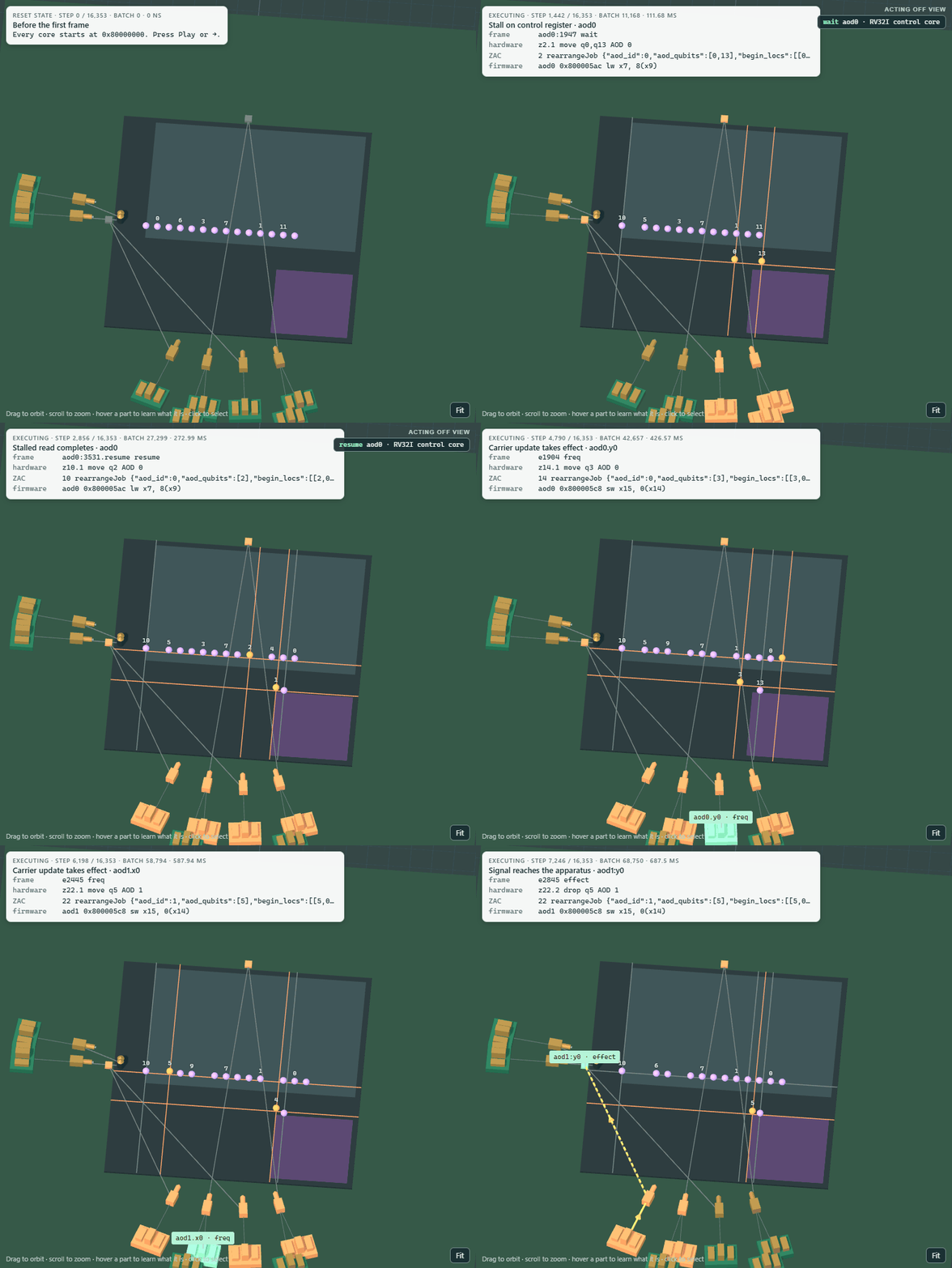
5Sound is slow
A new frequency does not move the beam at once. The sound wave must first cross the laser beam inside the crystal.
The model takes the crossing time as the beam width over the acoustic velocity: 4 mm (the beam of Endres et al. 2016)
over 650 m/s (the supplement of Lu et al., arXiv:2510.11451), which is
6.154 µs. This is a derived value, not a measurement of one device. It is the delay of every effect
frame on an AOD tone.
The lowering does not compensate for it, and the laser channels have no delay in the model. So in the atom plane a tone change lags a laser pulse fired on the same batch by 6.154 µs. The drop of the first job closes at the converters exactly when the first Rydberg pulse opens, but the end of its ramp reaches the atoms 6.154 µs after the Rydberg pulse has started, when the 0.36 µs pulse is long over. Whether ZAC's times are meant at the RF source or at the atoms, the program does not say.
Find the first effect frame on aod0:x0. How many microseconds after the pulse window
opens at the DAC does the change reach the atom plane (arrivesPs − atPs)?
6How fast can a tone be retuned?
A RISC-Q pulse generator does not just store a new frequency. It regenerates the phasors of all 16 sample lanes,
one lane per cycle, through one CORDIC unit. In the Lean model that takes 16 + 19 + 2 = 37 batches
(regenCycles in QControl/RiscQ/Timing.lean), and the slowest path of a carrier update has a
lead of 52 batches (theorem default_leads). If a second update lands before the previous regeneration has
finished, the first frequency never reaches the carrier. The model reports that as a fault:
carrier update lands before the previous phasor regeneration finished. The test
tests/riscq-neutral.test.mjs provokes it with two updates 20 batches apart.
Steps of 200 batches are far from that limit, and the same test file checks that no two steps of a tone in the ZAC run are closer than 37 batches.
You change STEP_BATCHES to 20 to make moves smoother. What does the simulator report?
- Nothing: smaller steps only add writes.
- A fault on the tone channels: each update lands before the previous phasor regeneration has finished.
- A compile error: the lead is too short.
- The atoms are lost.
What to remember
- ZAC's program fixes every time. Each rearrangement job becomes pickup, move and drop; Rydberg and Raman pulses are global.
- An AOD tone's frequency is a position: 80 MHz + 188,462 Hz/µm, in 0.13 µm steps of the 16-bit code.
- Pickup and drop ramp the tone's amplitude for 15 µs. A move steps the frequency every 2 µs along a constant-acceleration profile.
- Tone positions in the workspace are read back from the carrier updates in the trace.
- The acoustic delay is 6.154 µs (derived). Retuning faster than one phasor regeneration, 37 batches, is a fault.